


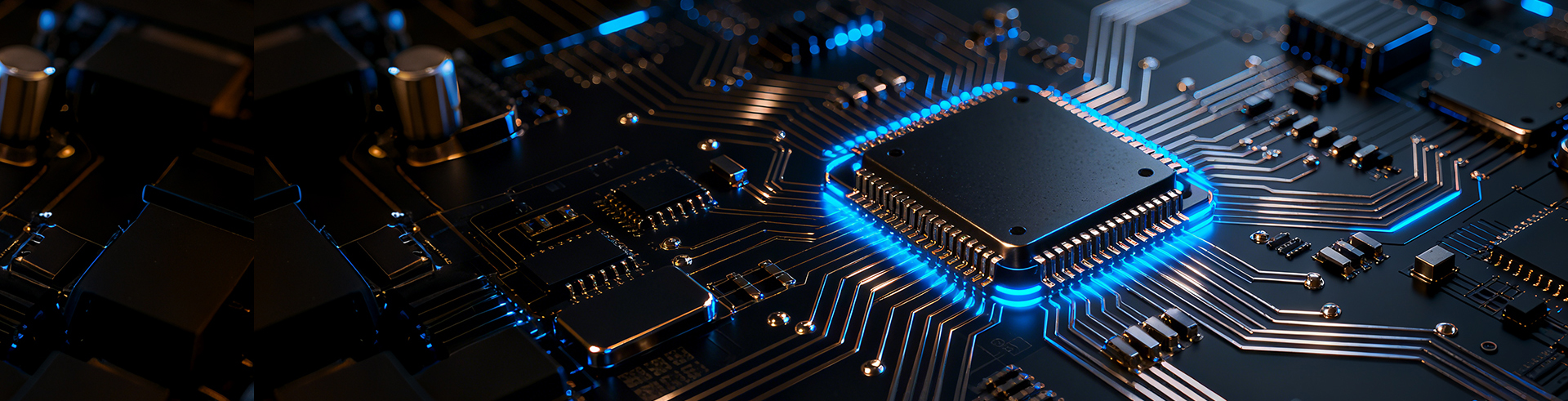

The full name of DAC is Digital-to-Analog Converter, which is called digital-to-analog converter or D/A converter in Chinese. It is an electronic device (integrated circuit chip) whose core function is to convert a digital signal to an analog signal.
Input: A digital signal. A numeric value usually represented in binary code (consisting of 0 and 1).
Output: Analog signal. It is a continuous voltage or current that is proportional to the input digital value.
You can think of it as a "translator" whose job is to translate the "digital language" that computers and digital circuits can understand into the "analog language" that the real world, such as speakers, motors, displays, can understand and execute.
The DAC works based on a reference voltage (or reference current) and a set of precise resistor networks (such as R-2R trapezoidal networks) or capacitor networks.
1 Input digital code: The MCU (microcontroller) or DSP (digital signal processor) sends an N-bit binary digital code to the DAC via a parallel or serial (such as SPI, I2C) interface (for example, the code range for an 8-bit DAC is 00000000 to 11111111, that is, 0 to 255).
2 Internal decoding: The switching network inside the DAC precisely switches the connection of internal resistors or capacitors based on the received digital code.
3 Generate analog: The combination of these switches divides a stable reference voltage (Vref) proportionally, resulting in a corresponding analog voltage value.
For example: For an 8-bit DAC with a 5V reference, the digital code 00000000 (0) corresponds to a 0V output; Code 10000000 (128) corresponds to (128/256) * 5V = 2.5V output; Code 11111111 (255) corresponds to (255/256) * 5V ≈ 5V output.
Key performance parameters of the DAC
When selected and procured as "electronic material", engineers mainly focus on the following parameters:
| Parameters | Definitions and Instructions | Application Impact |
| Resolution | The number of levels of discrete analog values that a DAC can output is usually expressed in bits. | The higher the number of bits, the smoother the output and the higher the precision. For example, a 16-bit DAC is much finer than an 8-bit DAC. |
| Conversion rate | The number of times a DAC can convert from digital to analog Per Second, typically measured in MSPS (Mega Samples Per Second, millions of samples per second). | Which determines the maximum frequency of the output waveform, high conversion rates are required for high-speed applications such as video and communications. |
| Setup time | The time required from when the digital input changes to when the output analog voltage reaches and stabilizes within the specified error range of the final value. | Affecting dynamic performance is crucial for signals that change rapidly. |
| Accuracy | Including DNL (differential nonlinearity) and INL (integral nonlinearity), measure the deviation between the actual output and the ideal output. | DNL affects the monotonicity of the output level, INL affects the overall linearity, and the higher the precision, the smaller the error. |
| Interface type | The way of communicating with the controller, such as parallel, SPI, I²C, etc. | It affects connection complexity and communication speed. The SPI/I²C interface is simple and has few pins; Parallel interfaces are fast but take up more pins. |
| Output type | Voltage output type or current output type. | Voltage output type is more common and directly drives the subsequent circuit. Current output types are often used in industrial fields or to drive specific loads. |
4. The main types of Dacs
Voltage output type DAC: Most common, directly outputs analog voltage.
Multiplicative DAC: Its reference voltage can be variable, and the output is the product of the digital code and the variable reference voltage for applications such as modulation.
Current rudder DAC: Based on current switching, it has a very high conversion speed and is often used in high-speed fields.
Δ-Σ DAC: Achieving extremely high resolution (such as 24-bit) through oversampling and noise shaping techniques, mainly used in high-precision audio fields.
5. Applications for Dacs (Why Do You Need It?)
DAC is the bridge connecting the digital world to the analog world, and almost all modern electronic systems cannot do without it:
Audio playback: This is the most classic application. Mobile phones, computers, MP3 players convert digital audio files (such as MP3s) to analog voltage signals through Dacs, which are amplified by power amplifiers to drive headphones or speakers to produce sound. High-end Hi-Fi audio systems have extremely high requirements for DAC performance.
Video output: The graphics card converts digital image data through the DAC to an analog VGA signal and transmits it to an old-fashioned CRT monitor or projector.
Industrial control: The MCU outputs digital code, which is converted by DAC to analog voltage (such as 0-10V) or current (4-20mA) for precise control of servo motors, frequency converters, valve opening, temperature, etc.
Waveform generation: In instruments such as function signal generators and oscilloscopes, Dacs are used to generate various complex analog waveforms (sine waves, square waves, triangular waves, etc.).
Data acquisition system: Usually used in conjunction with an ADC (analog-to-digital converter) to form a closed-loop control.
As an electronic material, DAC can be precisely defined as:
An integrated circuit chip that converts discrete digital signals into continuous analog signals, whose core performance is measured by parameters such as resolution, conversion rate and accuracy, is a key interface device for digital systems to interact with the analog real world, and
Phone
+86 13714130672


Address
Room 1505, Senye Chuangda Building Gushu 2nd Road, Xixiang Street Bao'an District, Shenzhen China