


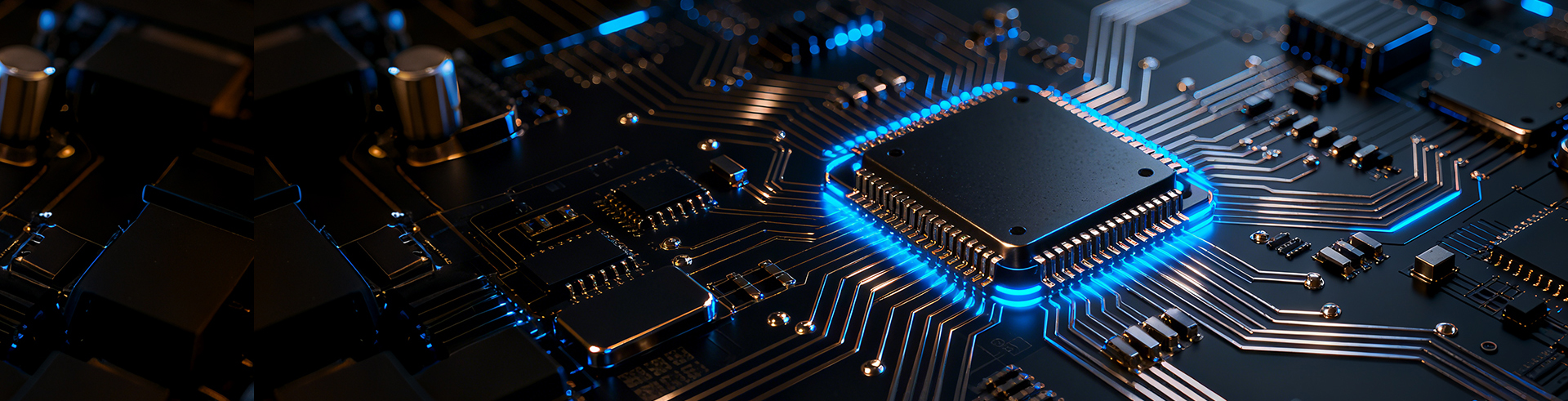

CMOS (Complementary Metal-Oxide-Semiconductor, complementary metal-oxide-semiconductor) is a semiconductor technology widely used in digital and analog integrated circuits. Its core feature is the use of both N-channel MOSFETs (NMOS) and P-channel MOSFETs (PMOS) simultaneously to form a complementary structure, thereby achieving low power consumption and high performance.
The basic unit of a CMOS circuit is the CMOS Inverter, which consists of a pair of NMOS and PMOS transistors:
l NMOS (N-channel MOSFET) : responsible for Pull-down, conducting when input is high and outputting low levels.
l PMOS (P-channel MOSFET) : Responsible for Pull-up, it conducts when the input is low and outputs a high level.
l At steady state (logic 0 or 1), there is always one cut-off in both NMOS and PMOS, with almost no quiescent current (only leakage current).
l CMOS consumes very little power compared to common MOS (such as NMOS or PMOS) and is suitable for battery-powered devices (such as mobile phones, IoT devices).
l Because the output level can be stabilized at VDD (high level) or GND (low level), the CMOS is more resistant to power supply fluctuations and noise.
l The NMOS is responsible for the fast pull-down (low level), and the PMOS is responsible for the fast pull-up (high level), which makes the signal switching faster.
l CMOS processes are suitable for large-scale integrated circuits (such as cpus, memory) and support nanoscale processes (such as 5nm, 3nm).
CMOS technology is widely applied in:
1. Digital integrated circuits:
¢ Microprocessor (CPU, GPU)
¢ Memory (SRAM, DRAM, Flash)
¢ FPGA (Programmable Logic Device)
2. Analog integrated circuits:
¢ Data Converter (ADC/DAC)
¢ Radio frequency (RF) chip
3. Sensor:
¢ CMOS image sensor (CIS, like a mobile phone camera)
¢ Biosensors
4. Low-power devices:
¢ IoT devices
¢ Wearable devices (smartwatches)
Characteristics | CMOS | Common MOS (NMOS/PMOS) |
Structure | NMOS + PMOS (Complementary structure) | Only NMOS or only PMOS |
Static power consumption | Very low (nA level) | Higher (with a direct current pathway) |
Speed | Fast (symmetrical switching) | NMOS is faster, PMOS is slower |
Noise tolerance | high | Lower |
Integration | High (suitable for large-scale ics) | Lower (early simple circuits) |
Typical Applications | CPU, memory, mobile phone chip | Early calculators, simple logic circuits |
Despite the obvious advantages of CMOS, there are still some challenges:
l High manufacturing cost: Both NMOS and PMOS processes need to be optimized simultaneously.
l Dynamic power consumption issues: Capacitor charging and discharging during high-frequency switching leads to increased power consumption (modern chips use technologies such as DVFS for optimization).
l Short-channel effect: The leakage current increases when the transistor size shrinks to the nanoscale (addressed by new technologies such as FinFET and GAAFET).
l 3D integration: such as 3D NAND, Chiplet.
l New device architectures: FinFET (Fin field-effect transistor), GAAFET (Surrounding Gate transistor).
l Low power optimization: Near-Threshold Computing (NTC), asynchronous CMOS.
CMOS, with its low power consumption, high integration, and high reliability, has become the mainstream technology of modern integrated circuits and is widely used in computing, communication, storage, and sensing. With process advancements (such as 3nm, 2nm), CMOS will continue to drive the development of electronic technology.
Phone
+86 13714130672


Address
Room 1505, Senye Chuangda Building Gushu 2nd Road, Xixiang Street Bao'an District, Shenzhen China